I’m working on a deadline right now. I have projects to start, projects to finish, promises to keep and time is a’wasting.
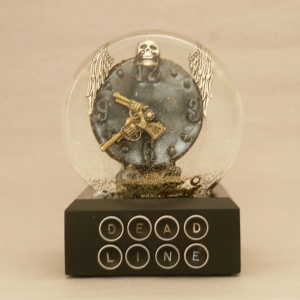
Thinking about deadlines in general inspired me to make a snowglobe a little off my usual style. It started with a typewriter, which you can barely see after the “deadline” took over the rest of the real estate.
Here’s why my artwork can take so … much … time.
I imagine there are artists out there who sketch out an idea, make it the first time and go have lunch. Not me. First, I get the idea that I want an old-fashioned manual typewriter in a snowglobe. I keep working on this concept, off and on for weeks, until I’m satisfied with one tiny typewriter that will fit inside a snowglobe. It’s black, so I paint each tiny key with an outline of silver to stand out a bit. This step takes about next to forever, because the typewriter itself is only 2 inches wide and each key is about the size of a pencil tip. I fuss forever with the look of the platen and add separate metal pieces for the ribbon spools. And I wanted the typewriter to SAY something, so I remember that I procured a lot of printer’s type years ago, and I have to dig around in my storage areas until I find it. It’s jumbled up a bit. I put the arial and helvetica off to the side — it’s just not right for the old feeling of a heavy manual typewriter. Here it is: a tray of Times New Roman, close enough to the formal typeface used on an old manual typewriter.
It’s a gorgeous Colorado day, so I set myself up a temporary workshop in the backyard, and begin sorting tiny pieces of type, looking for the letters I need: D, E, A, D, L, I, N, E. I need two of the letter “E” and “D.” Well, THAT doesn’t take that long, and I’ve got them. Only I discover what I’d forgotten about printer’s type, which is that different sizes of letters have a different groove on the metal to identify the type and size, and hold them all in place when printing. To prevent a typesetter from using mix and match letters that appear similar, each size has a groove at different height.(For those who like to learn a new fact every day, I looked it up: the correct title for the groove is the “Nick.” Not too glamorous, but don’t we all feel much smarter now that we know?)
And I apparently have acquired some 10 pt and some 12 pt Times Roman in my happily spelled word. Back to the sorting trays until I have my word, all in 10 pt type. I wrap wire around the group of letters to hold them tight — using the NICK groove — and scrounge around for a hammer and some sheets of thin art metal which is black on one side and silver on the other: perfect. But what to hammer on? My work surface is crammed with too many bits and pieces of half-made snowglobe interiors, and the finish on the kitchen table can’t take me hammering … wait, where’s that really heavy cutting board? Under the sink? The wooden one we quit using because some tv show said wooden ones hold bacteria, and it was too pretty to mark up with knife marks anyway. It had like seven types of wood, beautiful stripes of gold and brown …
Yes, there it is, the beautiful handmade one that Rick made for me in college. Whatever happened to Rick, anyway? He had a cool last name, I bet I could find him if I looked. I wonder if … oh, right. I was doing something. What was it? Hammering printers type into metal to create a tiny metal document for my tiny typewriter for the snowglobe I am already calling “Deadline.” Because it should have been finished yesterday.
I tell myself that Rick would love to know that his cutting board is going to such good use, that I even still have it all these years later, and proceed to hammer out the word “DEADLINE” repeatedly until I get a series hammered into the metal that looks decent. Looks darn good, I think.
I cut the metal strip about an inch wide, and place behind the tiny platen on the tiny typewriter. The metal strip’s way too long to be a single piece of paper, so I curl it around the barrel of an Exacto knife and let it scroll out, curling gracefully behind the typewriter, reminding me of the legend of Jack Kerouac and how he typed his great American novel on a single long piece of paper. I wonder if he found a roll of paper to type on or taped a lot of sheets together. Did I used to know that fact? How much tape would that take anyway? Do I need to buy some tape? I think we might have used it up during the holidays. I really should put that on my shopping list. I like that tape that goes down kind of dull, matte, not shiny … what’s that called, “Magic Tape?” Something like that … it’s practically invisible. Remember when I took all those scraps of wrapping paper and taped them together like a crazy quilt and wrapped Uncle Sam’s gift? Christmas in Chicago. That was SO cool. I didn’t think people really stopped and admired that quilted paper as long as they could have. It was a thing of beauty. Maybe next year …
Oh, yeah. Hammering. Looking good. Back to deadline … deadline … I need something that says TIME. Time is running out. Time is … something. An hourglass? A clock? Yeah, a clock. But … what makes a clock say “deadline.” Should it be an alarm clock? How about an Alarmed Clock with exaggerated eyebrows and little raised hands showing surprise. No, that’s another design, another idea. Wait. I got it. Yeah, I got it. Deadline. The clock hands are … guns. Oh, yeah, now we are talking. The typewriter is typing a murder mystery and the clock has gun hands. It makes sense to me in that alternative universe kind of way. I add two different handguns to the face of the clock and admire my work. How the heck is the clock going to fit into the design? I’ve made it far too big to stand alone. I rest it on the typewriter itself and decide that’s the best spot for it. The typewriter was just sitting there kind of flat anyway, so the clock will rise up out of the platen, and the scrolled paper flows out behind it.
It’s not enough. Typewriter, metal scroll, clock, gun hands. Meh. It’s a hot fudge sundae with no cherry on top. Incomplete.
I got it. Wings, silver wings. We’ll make the clock more ominous by adding wings. Looking for metal wings in my box of “this stuff might be useless, but too cool to throw away” stuff, I find one tiny metal skull instead. Who gave this to me anyway? I think someone sent it to me … no, not a stalker, but I ordered something, and they put some odd items as a “free gift” with the packing materials. Since you never know when you might need a 3/4″ tall silver skull, I saved it. (I pat myself on the back for proving, once again, that hoarding tendencies pay off, one in every 100 times. Or so.)
I assemble the wings and skull into the interior sculpture. Unlike my usual pieces, rich with bronze and antique gold, coppers and browns, this piece is stark with silver and black. In some odd way, I like it. I send it off to the Snowglobe Engineer who knows how to make the magic happen. I wait. But not that long …
The Snowglobe Engineer calls. Did I forget how large the opening is for a 4″ snowglobe? Well, I know the typewriter, barely two inches wide, would fit inside the glass, but apparently when you add a large clock face, wings and a skull, it won’t. Obviously, it can’t be folded in half and opened inside like a ship in the bottle. We debate design changes to make it fit inside, moving the wings, giving up the skull … and settle creatign a larger globe. This means we need to locate a larger glass globe and larger opening. This means the snowglobe base which I have already finished won’t fit the globe size, so back to the drawing board there.
I have other boxes of “important do not throw away things”, waiting to expose themselves to me and start the crazy idea process. Boom! It hits me: I have a whole bunch of typewriter keys from a long-abandoned project. Poor dismantled typewriters, gave their lives to sit in a shoebox in my garage. These keys are so old and dark, aged and grimy, I can barely read the letters. Finally, I pick through the piles and find D, E, A, L, I, N … no, that won’t work. “Dealin'” is a whole different snowglobe. Oh, of course. Typewriters only have ONE of each letter, unlike a drawer full of printer’s type with multiple vowels and duplicates of everything. I have one more set of old typewriter keys … there it is: another D and an E. I set them out and think: yeah, this is coming together. I remember why I abandoned the earlier project, it just makes me so sad that these old typewriters get chopped up. It’s a conundrum for me, because I love the look of old typewriter keys, but the typewriters I’ve known personally (and still own) are too precious for me to attack with a pliers and hack saw, even if I don’t type on them anymore. I make a mental note to drag my cast iron typewriter out of storage in the basement and start using it again. Remember how strong your fingers got? I could practically do one-finger pullups (well, in my mind, I could.) When was the last time I had it out, anyway? Oh, yeah, for that photo essay. That was really cool. I took a photo of the typewriter and then photo-shopped new keys on the keyboard to spell out a sentence.
In real life there is no backspace.
Profound. It should be my motto. Maybe I’ll use that as a blog title. I meant to have that printed and framed for my office. Where is that image anyway? On a flash drive? In my folder called “art projects” — I really should find … No. I really should finish this snow globe base. For Deadline. Remember? Deadline? Deadline the Globe, and Deadline as in the “time at which you promised to finish something” which is not yet done?
The typewriter keys are heavy and beautiful and I take them inside to clean them up, polishing each one with a soft toothbrush until the years of grime are rubbed away and the hopeful key looks back at you. “It’s a new day,” I say. “You get to be on a snowglobe.” I take little comfort in knowing “I” did not tear them from their usefulness on the keyboard, someone else did the deed. I can’t help but wonder what these keys typed. Did this key write school reports on the history of the world before anyone had heard of WWII? Before the atom bomb existed? Before the Euro? Before Nintendo and Farmville and McDonald’s existed? While Tesla WAS STILL ALIVE? Did kids even use typewriters back then? Or did they use that spidery cursive writing, dipping their quill pens thoughtfully into six-sided glass jars of India ink and staining their fingertips blue, and the tip of their tongues if they thoughtfully chewed on the pen tip, while thinking of a synonym. You know, they are talking about giving up on cursive writing in the grade schools. Really. How sad. I mean, it makes sense, but it’s something that will go away. Forever. Not that anyone I knew had the beautiful cursive you see in old movies, mine was always legible but rushed, and scrunched up where it should have been curlicued and ornate. Those wide ovals in the loops, the dipping lowercase “g” and “y” … I remember always hesitating before writing an uppercase “Q” in cursive … it never EVER looked like a letter “Q” to me, and I tended to cheat and use a non-cursive version, just to be understood.
If cursive isn’t taught in schools, not only will kids not write it, they probably won’t be able to READ it eventually. There will be little hobbiest clubs springing up, “Society for the Restoration of the Cursive Word,” where people gather to copy sonnets in flowing cursive, and younger people bring letters from great-great grandparents to be translated, as they will have no idea how to make sense of the squiggly lines on the pages of the thin airmail paper. For all they know, it’s Italian. Or Icelandic. Alas!
Must Not Get Distracted.
I look at the word “DEADLINE” and realize I have used up four vowels from two different keyboards. Seriously? Pretty much makes the remaining letter keys in the box useless except for words with “O” and “U” in them. Like Boom, or Boob — but I’d need two letter “B” again, so that’s no good. There’s “good” and “food” … no, quit using double vowels. You are wasting a precious resource. Conserve! Protect! Use Wisely, or you’ll just end up making cufflinks for guys with consonants in their names.
The typewriter keys now need to be sanded and flattened so they can be affixed to the base. But snowglobes have a front and back, and the back of this one looks rather lonely. Needs something. Back in the day, reporters often finished their stories with three symbols in a row, ###. But THAT would require killing a third typewriter, and that seems a bit much. The alternative is -30- and I figure I can do it without the dashes, because they don’t seem to exist on these ancient keys. So I dig around and come up with a three, and a zero, and call it good.
It all comes together and there it is. As we used to say in the newspaper world,
-30-
This slideshow requires JavaScript.
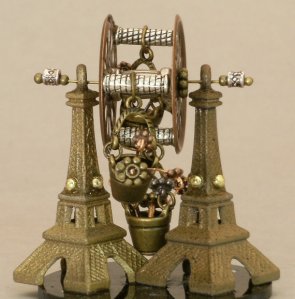
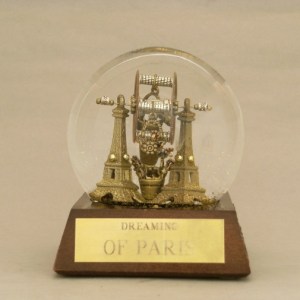
 I have a friend who told me that she is always dreaming of Paris, which inspired this sculpture, made more of Paris dreams, than Paris reality.




 Camryn Forrest Designs